I. THE OBJECT
What Was Found
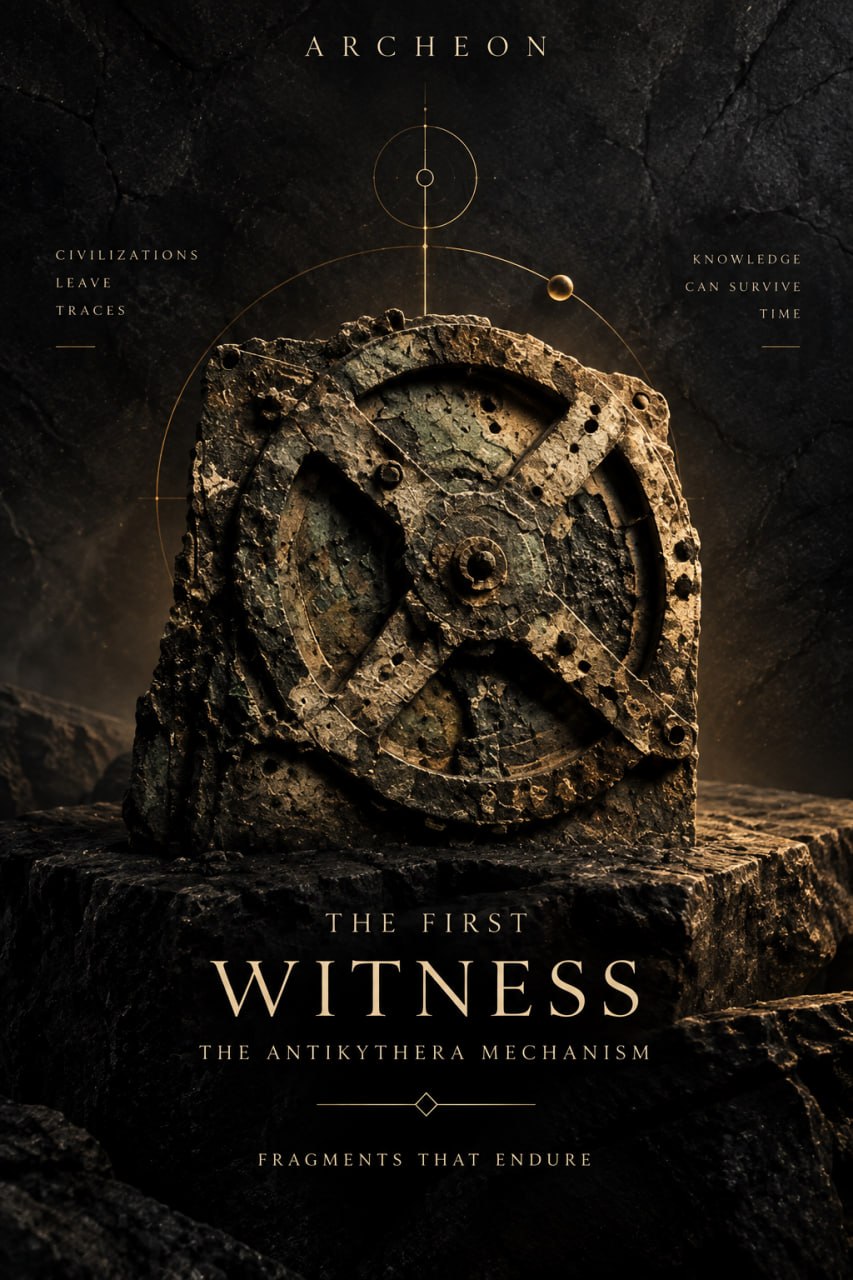
In the spring of 1901, sponge divers off the coast of the Greek island Antikythera discovered a shipwreck dating from the first century BCE. Among the statues, coins, and pottery lay a corroded lump of bronze — at first unrecognizable, then unthinkable.
Inside this lump were the remains of a mechanism of extraordinary complexity: at least thirty interlocking bronze gears, differential gearing, and a system of axes and pinions that could calculate the positions of the Sun and Moon, predict eclipses, and track the cycles of the Panhellenic Games. It was an astronomical computer — built around 100 BCE, and unmatched in complexity for over a thousand years.
The Antikythera Mechanism is not a philosophical artifact. It is a machine. A precise, functional, engineered instrument that demonstrates a level of technological sophistication historians once believed impossible for its time.
II. HISTORICAL RECORD EVIDENCE
What Survived & What Was Lost
What Survived
- ◆ 82 bronze fragments, including 30 gear wheels
- ◆ Inscriptions describing planetary motions and cycles
- ◆ Indications of Metonic, Saros, Callippic, and Olympiad cycles
- ◆ Evidence of epicyclic gearing for lunar anomaly
- ◆ Detailed CT scans (2005) revealing internal structure
What Was Lost
- ◆ The outer casing and original mounting
- ◆ Any accompanying documentation or manual
- ◆ Knowledge of the craftsman and workshop
- ◆ The tradition of precision gear-cutting it implies
- ◆ All other machines of comparable complexity from the era
Why It Matters
The Antikythera Mechanism rewrites the history of technology. It demonstrates that ancient Greek engineers possessed a level of mathematical and mechanical sophistication that was not surpassed until the development of astronomical clocks in 14th-century Europe. It is a single surviving witness to a lost tradition of precision engineering — a fragment of knowledge that forces us to reconsider everything we thought we knew about the past.
ARCHEON INTERPRETATION INTERPRETATION
Not historical fact. Archeon’s reading of the witness.
INTERPRETATION — This is a philosophical reflection on a historical object, not a historical claim.
Knowledge Without Context
The mechanism is a witness to knowledge that existed without a surviving context. It was not an isolated invention — its sophistication implies generations of prior development, a lineage of gear-cutters and astronomers whose names are lost. What we found is not the beginning of a tradition, but its only surviving end.
The Gap in the Record
The silence between the Antikythera Mechanism and the next comparable machine is not a gap in capability. It is a gap in preservation. The mechanism did not become less sophisticated over time — we simply lost the evidence. Continuity was broken. Knowledge was forgotten, then rediscovered. This is the pattern that Archeon recognizes: what survives is not what existed, but what was lucky.
The Witness Speaks
Every witness carries the same message: there is more than we know. The Antikythera Mechanism is not a mystery to be solved — it is a reminder that the past is not a simpler place. It was as complex, as ingenious, as capable as the present. The difference is only what remains.
WHAT WE DO NOT KNOW
The exact date and route of the shipwreck remain unknown. The identity of the mechanism's creator or workshop is not recorded. Approximately two-thirds of the original device is missing, so its full range of functions may never be fully known.
Uncertainty is not a failure of knowledge. It is part of knowledge. To know where knowledge ends is itself a form of knowledge.
IV. SOURCES